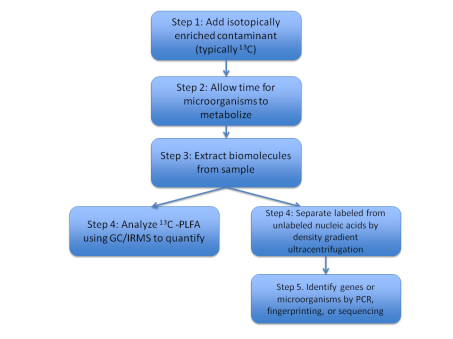
The stable isotope probing (SIP)A synthesized form of the contaminant containing a stable isotope (e.g., ¹³C label) is added. If biodegradation is occurring the isotope will be detected in biomolecules (e.g., phospholipids, DNA). method includes a family of techniques that all use individual contaminants (probes) that are enriched with stable isotopesForms of an element that do not undergo radioactive decay at a measureable rate. (such as 13C-labeled benzene or 15N-labeled RDX) to characterize contaminant-specific biodegradationA process by which microorganisms transform or alter (through metabolic or enzymatic action) the structure of chemicals introduced into the environment (USEPA 2011). processes. The underlying principle of all SIP techniques is that biodegradation of isotopically-enriched contaminants results in the selective labeling of biomoleculesClasses of compounds produced by or inherent to living cells including phospholipids, nucleic acids (e.g., DNA, RNA), and proteins. such as DNA, RNA, or phospholipidA type of biomolecule that is a primary structural component of the membranes of almost all cells. fatty acids (resulting in 13C- or 15N-lableled DNA or 13C-labeled fatty acids) in organisms that are responsible for degradation. A flow diagram showing the basic protocol for SIP studies is provided in Figure 7-1.
Unlike most other EMDs, SIP techniques can directly and unequivocally establish whether biodegradation of a specific contaminant is currently occurring in a contaminated environment or sample from that site. SIP techniques can also be used to investigate whether changes in environmental conditions are likely to enhance or inhibit contaminant biodegradation. SIP approaches are unique in that they can also detect and identify microorganisms responsible for biodegrading specific contaminants, even if the microorganisms, enzymesAny of numerous proteins or conjugated proteins produced by living organisms and facilitating biochemical reactions (based on USEPA 2004a)., and genes involved in these biodegradation processes are presently unknown.
All SIP methods detect individual biodegradation processes by analyzing for the incorporation of stable isotopes from individual isotopically-enriched contaminants into either structural biomolecules in living microorganisms or terminal products (such as CO2 or CH4) released by contaminant-degrading microorganisms. Even though the name “stable isotopeTwo atoms with the same number of protons but a different number of neutrons. probing” suggests some similarity with another important EMD, “compound specific isotope analysis” (CSIA), these two techniques are fundamentally different in two key respects. First, SIP uses individual contaminants that have been chemically synthesized to have artificially elevated levels of a particular stable isotope (such as 13C). In contrast, CSIA detects process-specific changes in the natural-occurring levels of stable isotopes in individual contaminants. Second, SIP analyzes the isotopic composition of biomolecules generated by the microorganisms responsible for biodegrading isotopically-enriched contaminants. In contrast, CSIA analyzes the impacts of biological and abiotic process on the isotopic composition of individual contaminants However, despite these important differences, the information generated by these distinct techniques can also be complementary, since both techniques can provide unequivocal evidence for biodegradation process and insights into the mechanism and microorganisms involved in these processes.
Relationships between SIP analyses and other EMD methods depend on the type of SIP approach used. For example, an SIP analysis involving isotopically-enriched DNA can often involve use of PCR and fingerprinting techniques such as DGGE. In this instance, PCR can be used to amplify 16S rRNAA subunit of the ribosome composed of ribonucleic acid (RNA). The RNA sequence is used to classify and identify microorganisms (e.g. genus and species). geneA segment of DNA containing the code for a protein, transfer RNA, or ribosomal RNA molecule (based on Madigan et al. 2010). sequences using SIP-generated 13C-enriched DNA as a template. These amplified genes are then separated and visualized using DGGE. Similarly, SIP analysis of PLFAs can also involve fingerprinting analyses as well as measurements of isotopic enrichment in specific PLFAs using mass-spectrometry. If both 13C-CSIA and 13C-SIP-based field studies are proposed for a site, the CSIA-based studies should always be conducted first to avoid prior introduction of a 13C-labeled contaminant. This is because the levels of 13C-enrichment required for 13C-SIP studies are many orders of magnitude greater than those that are generated by biodegradation processes and measured by CSIA.
Additional detailed information about the types of SIP analyses and their methodologies is available in the SIP Fact Sheet and in Section 7.4
Most current applications of SIP technique make use of contaminants that have enriched levels of 13C. 13C-based SIP techniques can potentially be applied to any type of environmental sample and can also be used to examine the biodegradation of any compound that is used by microorganisms as a sole (or predominant) source of carbon for growth. However, in current practice, SIP is used for two main purposes; (a) demonstrating that a specific contaminant undergoes biodegradation in a specific environment (PLFAPhospholipid fatty acids derived from the two hydrocarbon tails of phospholipids.-SIP) and (b) identifying organisms involved in specific biodegradation processes (DNA/RNA-SIP).
For example, a PLFA-SIP study using 13C-enriched contaminants could be used to determine whether often slow anaerobic biodegradation of contaminants like methyl tertiary butyl ether (MTBE) or benzene is currently occurring at a gasoline-impacted site. A DNA-SIP study at the same site could not only provide the same information about the biodegradation process, but also identify the organisms responsible for this activityRefers to when a microorganism performs a specific function (e.g., sulfate reduction, metabolism of benzene). Identification of these organisms could subsequently lead to the development of qPCR approaches that would enable these organisms to be quantified at the same or other sites.
Although SIP approaches are typically thought to provide unequivocal evidence for biodegradation of the contaminant under investigation, there are two important and related caveats that can sometimes impact the interpretation of results from SIP studies. First, biomolecules could potentially become isotopically-labeled if the contaminant under investigation undergoes abiotic chemical degradation (e.g. hydrolysis, chemical reduction/oxidation) at a significant rate. In this case the labeled biomolecules detected could be derived from microorganisms that have assimilated the abiotic degradation products derived from the contaminant rather than the parent contaminant itself. Interpretation of SIP studies therefore needs to recognize and address the stability of the contaminant under investigation. Similarly, in some instances the microorganisms that are responsible for directly biodegrading a contaminant can excrete partially degraded metabolites. These metabolites can then be assimilated by secondary microorganisms that are otherwise unreactive towards the parent contaminant. This second process is called “cross-feeding”. Cross-feeding can potentially strongly impact the interpretation of DNA/RNA-SIP studies which are typically used to identify organisms responsible for initiating the biodegradation of a contaminant. In contrast, cross-feeding has a much smaller impact if the aim of an SIP study is simply to demonstrate the biodegradability of a contaminant (e.g. PLFA-SIP).
Examples of several diverse applications of PLFA and DNA-SIP studies are provided in Table 7-1. This table is followed by a brief explanation of the major findings of several studies.
This study was conducted at the Zeitz aquifer in Germany. The site groundwater was largely anaerobic and contained high levels of dissolved benzene (~850 ppm) and toluene (50 ppm). A prior study at this hydrogenation plant (oil processing) site provided strong evidence for anaerobic toluene oxidation under sulfate-reducing conditions, but evidence for anaerobic benzene biodegradation was inconclusive. Bio-Traps® amended with 13C-benzene (98% 13C-enrichment) were deployed to conduct PLFA-SIP analyses of microorganisms present in several wells in the contaminated aquifer. An analysis of extracted PLFAs revealed substantial incorporation of 13C into specific PLFAs for the 13C-benzene-amended Bio-Traps®. However, this analysis was unable to further identify the organisms responsible for anaerobic benzene oxidation. Total PLFA measurements suggested a substantial microbial population (>107 cells/ bead) developed on Bio-Traps® amended with either toluene or benzene. Overall, the PLFA-SIP analysis provided strong evidence for anaerobic benzene oxidation that was not discernable through an analysis of the contaminant concentrations alone (Geyer et al. 2005).
A DNA-SIP analysis using TBA (99% 13C) was conducted on samples from several aerobic bioreactors designed to treat TBA-contaminated groundwater. In all cases, the reactors were self-inoculated with indigenous microorganisms present in the groundwater undergoing treatment. The study was designed to identify the native organisms responsible for TBA biodegradation on the reactor as a prelude to developing molecular probes to detect and quantify these native organisms in the groundwater environment. A PCR-DGGE analysis of 16S rRNA genes in 13C-enriched DNA demonstrated that several TBA-metabolizing bacteria were present and active in these reactors and that these organisms that were similar but far from identical to other TBA-oxidizing organisms previously identified and characterized in pure culture. Another PCR-DGGE analysis of specific genes present in 13C-enriched DNA demonstrated that several genes previously implicated in TBA oxidation in pure cultures were also highly conserved in the native TBA-oxidizing bacteria identified through DNA-SIP. Overall, the results of this study suggested that the full diversity of aerobic TBA-oxidizing organisms is large, although the enzymes and pathway of TBA oxidation may be highly conserved in these diverse organisms (Aslett, Haas, and Hyman 2011).
In this study, 13C-based SIP analyses were used to investigate the biodegradation of compounds that serve as carbon sources for microbial growth. In contrast, 15N-DNA-SIP can be used to investigate the biodegradation of compounds that can serve as nitrogen sources for microorganisms. In these types of studies, both an 15N-labeled compound and an unlabeled 12C compound were supplied simultaneously as N and C sources, respectively. In the study described here, 15N-DNA SIP was used to investigate the diversity of RDX-utilizing microorganisms in aquifer sediments and groundwater from Picatinny Arsenal. This site had a history of soil and groundwater contamination with explosives. Microcosms were supplied with cheese whey as a C source and 15N-RDX as an N source. Fifteen 16S rRNA gene sequences were amplified from purified 15N-DNA fraction and ten of these sequences were novel and unrelated to previously described RDX-degrading microorganisms. Six sequences of the xplA gene associated with RDX degradation were detected that were >96% similar to the xplA gene of a Rhodococcus strain previously shown to degrade RDX. It should be noted that when SIP is conducted for complex molecules with differing routes of metabolism, such as RDX (which may be used as a N or a C source), that it may not be possible to distinguish organisms performing an initial reaction on the parent molecule from those that incorporate C or N from metabolites. However, all of these organisms are part of the microbial communityThe microorganisms present in a particular sample. involved in degrading the compound in the environment (Roh et al. 2009).
This research project evaluated the use of Bio-Traps® (see Section 10.4 on sampling devices) amended with 13C-acetate as a method to conduct PLFA-and DNA-SIP analyses aimed at identifying microorganisms responsible for the biological reduction of U(VI) to U(IV) (Lovley et al.1991, 1992). A variety of bacteria, including some sulfate-and iron-reducing organisms, can reduce U(VI) using different electron donors, including acetate. Conventional geochemical measurements indicated stimulation of anaerobic respiration (iron-, sulfate- and U- reduction) followed acetate amendment. A PCR-DGGE analysis of 16S rRNA gene sequences amplified from 13C-enriched and total DNA suggested many members of the microbial community consumed acetate. Sequences similar to iron- (and U) reducing Geobacter sequences were identified in several samples close to the point of acetate injection and U reduction. Sequences representing sulfate-reducing bacteria were detected in samples down gradient from the acetate injection point. PLFA-fingerprinting conducted by GC/MS and determination of 13C-incorporation into specific PLFAs using CSIA provided results that largely agreed with DNA-SIP results. Overall, DNA-SIP and PLFA-SIP analyses both demonstrated a widespread ability of native organisms to assimilate acetate. Moreover, both SIP analyses provided distinct evidence for changes in microbial community compositionDescription of the types or identities of microorganisms present in a sample. that were consistent with observed reduction of dissolved uranium at the site (Chang et al. 2005).
The application, analysis, and interpretation of microbiology-based EMD methods differ from typical soil and groundwater geochemical measurement in a number of ways. For example, microbial biomarkers cannot easily be preserved, and sample handling and processing requires special care. The analysis of microbial parameters requires specific data quality considerations for sampling plans, sample collection and handling, quality control and laboratory procedures, and these are discussed in Section 10. Included below is a brief introduction to how SIP data are typically reported and some specific examples of how the data would be interpreted in answering the questions presented in Table 2-3.
Included in Table 7-2 below is information that should be provided in laboratory reports of SIP data including common laboratory report information, recommended information about the SIP method, and desirable information about the SIP method and results.
Additional information regarding sample handling and collection can be found Section 10.4 and Section 10.5
Different SIP techniques report data differently. The data generated from a PLFA-SIP analysis can include an estimate of the total amount of biomass (determined from total PLFA amounts), the bulk 13C enrichment of the total PFLAs extracted from a sample (reported as per mil or parts-per-thousand [‰]), the relative abundance of individual PLFAs, and the isotopic enrichment of individual PLFAs. Additional data can include the level of 13CO2, 13C-dissolved inorganic carbon, or 13CH4 detected. In some studies involving Bio-Traps®, the amount of 13C-enriched contaminant that has been degraded can also be reported based on the amount of 13C-enriched contaminant remaining in the Bio-Trap® after deployment in the field. However, if amounts or rates of biodegradation are desirable from Bio-Trap® SIP studies, in addition to data on labeled PLFAs or microorganisms, adequate controls must be included in a study to estimate contaminant losses from the Bio-Traps® due to desorption and diffusion, especially if the contaminant under investigation is highly water-soluble (such as MTBE, 1,4-dioxane).
A measurement of total PLFAs can provide an estimate of the numbers of microorganisms present in an environmental sample, even though this method does not rely on the use of isotopically-enriched contaminants. Changes in the total amount of PLFAs can be directly related to changes in the size of a microbial population. The detection of elevated (above background) levels of 13C in either bulk PLFAs, individual PLFAs or terminal products (CO2, DIC, CH4) are all unequivocal indicators that biodegradation of the 13C-enriched contaminant has occurred under the conditions examined in the study. However, the level of 13C-enrichment in these analytes is strongly dependent on at least two issues:
The effect of the level of 13C-enrichment in the labeled contaminant is straightforward. If a labeled contaminant contains only low levels of 13C-enrichment, a high level of 13C-enrichment in PLFAs or terminal products will indicate extensive biodegradation of the contaminant. Conversely, lower levels of biodegradation would be inferred if low levels of 13C-enrichment in PLFAs or terminal products are observed when using contaminants that are highly enriched with 13C. The effect of background contaminants (either the contaminant of interest or co-contaminants with similar core structures, such as benzene and toluene) is more complex, as concurrent biodegradation of these predominantly 12C compounds can dilute signals from 13C-enriched contaminants. For example, if a sample contains a high level of the contaminant of interest, the incorporation of 12C from the background contaminant into biomolecules or terminal products will effectively decrease the 13C signal obtained from the concurrent biodegradation of the 13C-enriched version of the contaminant. Knowledge of the background levels of contaminants and the concentration of contaminant probe used in an SIP study are therefore important considerations in data interpretation.
The results of DNA/RNA-SIP studies typically include identification of the “active” microorganisms detected in a sample based on an analysis of PCR-amplified 16S rRNA genes (such as DGGE). These identifications are based on comparisons of 16S rRNA gene sequences to sequences available in national databases. Other data might include estimates of the specific or relative abundance of individual organisms or functional genes based on fingerprinting (T-RLFP) analysis of purified 13C-enriched DNA. Additional data could include the level of 13CO2, 13C-dissolved inorganic carbon or 13CH4 detected.
In SIP studies of contaminant biodegradation, the similarity between 16S rRNA gene sequences is often used to infer the physiological capabilities of microorganisms detected within a sample by comparing them to the sequences of organisms that have been physiologically characterized in pure culture. For example, detecting a 16S rRNA gene sequence that is similar to Desulfovibrio sequences likely implies the detected organisms are also sulfate reducing bacteria (SRB). This type of comparison becomes less reliable when investigations focus on individual organisms with specific capabilities. For example, different DehalococcoidesDehalococcoides is a genus of organohalide-respiring bacteria (for example, bacteria that use chlorinated solvents as metabolic electron acceptors) within the phylum Chloroflexi, in the domain Bacteria, and currently represented by a single species, Dehalococcoides mccartyi (Dhc). This species is the only one known with strains that dechlorinate dichloroethenes (DCEs) and vinyl chloride (VC) to ethene and inorganic chloride. mccartyi strains can have different contaminant-degrading capabilities although they may have very similar, if not identical, 16S rRNA gene sequences. Currently, a working rule of a minimum of 97% sequence identity based on a comparison of the entire 16S rRNA gene sequence (~1540 base pairs) is regarded as a the threshold for identifying similar species. However, DGGE-based analyses often use much shorter DNA fragments (≤650 base pairs) for species comparisons and even full sequence similarity does not ensure that the two organisms under comparison have the same contaminant-degrading capabilities.
For the most part, SIP techniques are not inherently quantitative and their primary use in contaminant biodegradation studies is to demonstrate whether the contaminant biodegrades under a given set of environmental conditions. More elaborate studies can refine this information and identify which organisms are responsible for any observed biodegradation activity. To illustrate interpretation of SIP results, each question relevant to SIP in Table 2.3 is discussed.
A) Are contaminant-degrading microorganisms present?
In most cases, SIP analyses examine the biodegradation of organic compounds that are used by microorganisms as carbon and energy sources. Consequently, SIP would not be appropriate to determine the role of microorganisms in the fate of contaminants that are biologically transformed primarily through their use as electron acceptors (for example chlorinated solvents, PCBs, metals and others because organisms do not incorporate C or N into their DNA, RNA or lipidsA diverse range of organic compounds that are defined as being insoluble in water but soluble in non-aqueous solvents. Lipids include oils, waxes, and sterols. during this process). However, PLFA-SIP studies using field-deployed Bio-Traps® could be used to determine whether an important specific petroleum hydrocarbon (such as benzene) can be biodegraded at a site. PLFA-SIP can also determine what environmental modifications (such as addition of alternative electron acceptors) might promote the biodegradation of petroleum hydrocarbon compounds. Microcosm-based DNA-SIP studies could also be used identify native microorganisms responsible for the biodegradation of more unusual compounds such as explosives (RDX or TNT) or emerging contaminants like 1,4-dioxane. Like many other explosives, RDX is a nitrogen-containing contaminant. 15N-DNA-SIP could be used to determine whether RDX or other explosive compounds can be biodegraded. The organisms detected by this approach can be identified as capable of using explosive-derived nitrogen, but they are not necessarily directly biodegrading the explosives as growth-supporting carbon sources.
B) Are contaminant-degrading microorganisms active?
Both PLFA- and DNA-SIP intrinsically rely on the metabolic activity of specific contaminant-degrading organisms. A positive signal from either approach would confirm the activity of bacteria capable of biodegrading the specific contaminants used as SIP probes. These contaminants would include petroleum hydrocarbons, and possibly other compounds such as explosives, propellants, emerging contaminants. Typically SIP techniques would not be appropriate for demonstrating active biodegradation of contaminants that are typically used as terminal electron acceptorsCompounds used by microorganisms to support respiration. In aerobic organisms the terminal electron acceptor is oxygen (O₂). Anaerobic organisms use compounds other than O₂. These include common naturally–occurring compounds such as nitrate (NO₃⁻) or sulfate (SO₄²⁻) or anthropogenic contaminants such as chlorinated ethenes (e.g. perchloroethylene). Atoms from electron acceptors are typically not incorporated into biomolecules made by organisms that reduce these compounds during respiration. (such as chlorinated solvents, PCBs because, as previously noted, organisms do not incorporate C or N into their biomolecules during this process).
C) Are the microorganisms capable of complete degradation?
SIP approaches can be used to answer this question in two ways. First, if a specific organism or type of organism that completely degrades (mineralizes) a specific contaminant as a carbon source is already known, then either PLFA- or DNA-SIP can be used to demonstrate the presence and activity of that type of organism at a site. The second alternative does not involve an analysis of the traditional isotopic enrichment of biomolecules such as lipids or nucleic acids but rather examines the isotopic composition of terminal carbon-containing microbial metabolites, such as CO2 and CH4. Complete microbial degradation of a contaminant implies that biodegradation proceeds to the level of CO2 or CH4. The isotopic composition of these gases (the ratio of 13C/12C in CO2) can be readily determined and quantified by GC/MS and these data can be used to determine whether full or substantial mineralization of a 13C-enriched contaminant has occurred. This is the less direct and precise of the two methods for determination of complete degradation, and this approach requires prior knowledge of both degradation pathways and the stoichiometry of CO2 or CH4 production.
D) Is biodegradation occurring?
Both PLFA- and DNA-SIP intrinsically rely on the metabolic activity of specific contaminant-degrading organisms. A positive signal from either approach would unequivocally confirm the activity of bacteria capable of biodegrading the specific contaminant.
H) Are numbers of contaminant-degrading microorganisms and/or genes changing?
This question can be answered by using PLFA-SIP and assuming that the contaminant under consideration acts as a carbon and energy source for the contaminant-degrading organisms at a site. A time series of field-deployed Bio-Traps® using a 13C-enriched contaminant would enable a study of the changes in the microbial community over time. This approach would detect a change in the number of contaminant-degrading microorganisms through changes in the PLFA profile and the relative abundance of specific 13C-enriched PLFAs.
I) Is the remediation strategy affecting the numbers or types of contaminant-degrading microorganisms?
This question can be answered by using PLFA-SIP and assuming that the contaminant under consideration acts as a carbon and energy source for the contaminant-degrading organisms at a site. A time series of field-deployed Bio-Traps® using a 13C-enriched contaminant would enable a study of the changes in the microbial community over time. This approach would detect a change in the number of contaminant-degrading microorganisms through changes in the PLFA profile and the relative abundance of specific 13C-enriched PLFAs.
M) Is biodegradation occurring?
Both PLFA- and DNA-SIP intrinsically rely on the metabolic activity of specific contaminant-degrading organisms. A positive signal from either approach would confirm the activity of bacteria capable of biodegrading the specific contaminant used as an SIP probe.
N) What is the rate of biodegradation?
Estimates of biodegradation rates can be determined from some common PLFA-SIP applications using Bio-Traps®. These estimates are based on the amount of SIP probe depletion from the Bio-Trap® matrix as well as the accumulation of terminal metabolites such as CO2 and methane. These rate estimates are not based on incorporation of 13C from the labeled contaminant into microbial biomass, but rather on loss of the labeled contaminant from a Bio-Trap® and extracellular accumulation of labeled metabolites. As previously noted, if a rate determination is needed, controls must be used to account for losses due to abiotic processes, particularly desorption from the Bio-Trap® media.
O) Does the microbial community composition support the remediation strategy?
The use of PLFA-SIP using field-deployed Bio-Traps® can partially answer this question on a contaminant-specific basis. The principal limitation of PLFA analysis is that physiologically distinct types of bacteria can produce the same phospholipids. Unless there are distinctive PLFAs associated with microorganisms responsible for a particular activity, the resolution of PLFA-SIP is limited.
P) Do contaminant-degrading microorganisms continue to be sufficiently abundant?
A time series of field-deployed Bio-Traps® using a 13C-enriched contaminant and PLFA-SIP would enable a study of the changes in the microbial community over time. This approach could detect a change in the number of contaminant-degrading microorganisms through changes in the PLFA profile and the relative abundance of specific 13C-enriched PLFAs.
Q)Are contaminant-degrading microorganisms remaining active?
Both PLFA- and DNA-SIP intrinsically rely on the metabolic activity of specific contaminant-degrading organisms. A positive signal from either approach would confirm the activity of bacteria capable of biodegrading the specific contaminant used as an SIP probe.
U) Is biodegradation occurring?
See response in Question M.
V) What is the rate of biodegradation?
See response in Question N.
Some variability in site closure requirements exists among states and programs. However, in many situations, EMD data could serve as an additional line of evidence for understanding what processes are important in reducing concentrations and reaching the applicable closure levels. The evidence provided by EMD data would reveal whether biodegradation processes are occurring, have sufficiently proceeded, and are likely to continue. The following questions can be addressed for site closure.
W) Is contaminant degradation likely to continue?
Both PLFA- and DNA-SIP intrinsically rely on the metabolic activity of specific contaminant-degrading organisms. A positive signal from either approach would suggest the activity of bacteria capable of biodegrading the specific contaminant used as an SIP probe would continue. A time series of field-deployed Bio-Traps® using a 13C-enriched contaminant would enable a study of the changes in the microbial community over time and support and assessment of the likelihood of degradation continuing.
Y) Is biodegradation occurring?
See Question M.
Z) What is the rate of biodegradation?
See Question N.
If the exposure of a sample to a 13C-enriched contaminant probe occurs in a laboratory microcosm-based system, biodegradation rates can be determined, especially if continuous sampling for contaminants or terminal products is possible. Under these circumstances, SIP studies should include replicate samples, control samples with unenriched contaminant, as well as suitably poisoned controls. Samples should also be analyzed at locations within and outside the area impacted by the contaminant.
Since SIP involves analysis of biomolecules, particularly phospholipid fatty acids and DNA, avoid contamination of samples with other microorganisms and store samples so that the biomolecules present in the sample are not destroyed or altered until they have been extracted. For example, field samples should be stored and transported on ice (but not frozen) and extracted promptly. During extraction of DNA from environmental samples, all forms of DNA will be collected in the extract (including DNA present in microbial cells, as well as potentially large amounts of free DNA released from dead organisms). While free DNA from dead cells can be problematic for some molecular studies, DNA-SIP focuses on the analysis of 13C-enriched DNA obtained from living cells that have grown on the 13C-enriched contaminant probe. Free DNA present in the sample under analysis will be predominantly 12C-enriched and will therefore not be detected. This may not be true of other EMDs that simply analyze total DNA extracted from a sample.
Extraction efficiency of the biomolecule under investigation, is important since the concentration of 13C-enriched contaminant and micronutrients in microcosm-based SIP analyses can affect PLFA-SIP and DNA/RNA-SIP results. While chloroform/methanol extraction is a well-characterized process for extracting microbial lipids, the efficiency of DNA extraction from soils and other media can be highly variable, even when using commercial kits. Sequential extractions can greatly increase the overall yield of DNA, although the composition of the microbial community reflected in each extraction step does not significantly alter the overall species diversity detected by DNA-SIP (Jones et al. 2011).
Another important consideration is the concentration of 13C-enriched contaminant used in SIP studies. If samples are exposed to abnormally high concentrations of contaminants, the detected microorganisms may not reflect the organisms capable of degrading the contaminant at lower, more relevant in situ concentrations. At best, this effect may provide misleading information about which organisms are involved in a particular biodegradation process. At worst, it may suggest that a contaminant that does not biodegrade at low concentrations actually does biodegrade at the higher concentrations used in the SIP analysis. The inclusion of micronutrients in microcosm-based SIP analyses can also alter the biodegradability of a contaminant because the nutrients may be limiting in the environment from which the sample was taken.
All PLFA-SIP studies involve three key sequential steps:
In many instances PLFA-SIP studies have been conducted in the field using Bio-Traps® (see EMD Sampling Methods Fact Sheet and Section 10.4.5 for more information concerning the use of Bio-Traps) amended with 13C-enriched contaminants. Total lipids are extracted from samples using chloroform/methanol and then converted to fatty acid methyl esters (FAMEs) using trimethylchlorosilane. Absolute concentrations of PLFAs are determined by GC/MS using spiked internal standards. Membrane-derived PLFAs are obtained from total lipid extracts by separation into neutral, glycol, and polar fractions. The polar fractions (PLFAs) are then converted to fatty acid methyl esters (FAMEs) using trimethylchlorosilane. Individual FAMEs are then quantified by GC/MS analysis. The 13C-enrichment of individual PLFAs is determined using GC-IRMS. Production of 13CO2 or 13CH4 is also determined by GC/MS analysis. Additional details on methods used for SIP are provided in Busch-Harris et al. 2008.
One important constraint on the use of DNA/RNA-SIP in field studies of contaminant biodegradation is that this form of SIP requires contaminants with high levels of isotopic enrichment. In the case of 13C-enriched compounds, this requirement comes from the need to separate 12C- and 13C-labeled forms of nucleic acids using density gradient centrifugation. The degree of separation of isotopically distinct nucleic acids is directly impacted by their level of 13C-enrichment. This separation and the value of the information derived from this technique is maximized with high levels of 13C-enrichment (as high as 100% 13C). In general, the cost of even simple and widely available 13C-enriched compounds (e.g. 13CH4) increases as the level of enrichment increases. Less common organic compounds with the high levels of 13C-enrichment often require custom synthesis, and these compounds can therefore be expensive. Because field SIP studies often require relatively large amounts of labeled compounds, DNA/RNA-SIP has most often been used in laboratory-based settings using microcosms containing appropriate samples (soil, water) and the isotopically-enriched contaminant. After biodegradation of the contaminant has been observed, total DNA is typically extracted using commercial kits (such as the PowerMax® Soil DNA isolation kit from MoBio Laboratories, Inc, Carlsbad, CA). 12C-DNA is then separated from 13C-DNA by CsCl density gradient (140,000 x g for 69 hours at 20°C). Separated DNA fractions are visualized with UV light and removed from each centrifuge tube using sterile needles or by displacement and fraction collection. The resulting DNA is then isolated from each fraction by n-butanol extraction and ethanol precipitation. Purified 12C- and 13C-DNA samples from CsCl gradients are then typically used as templates in PCR reactions and subsequent analyses by DGGE or other fingerprinting methods.
Since in situ SIP techniques involve the introduction of a small amount of stable-isotope labeled organic contaminant (generally mg quantities) into the subsurface, regulatory agencies may have specific regulatory requirements (see Section 11) for SIP above and beyond the traditional work plan approval process. Involve the appropriate regulatory agency early in the site investigation/remediation process, and ensure that the regulatory agency has a good understanding of the SIP technique to be used at the site. Since SIP is a relatively new technology to site investigation/remediation, the regulatory requirements may vary widely, with some regulators incorporating the approval of SIP within the overall project approval process, while other regulators may have a separate permitting process.
Various recent modifications to the SIP techniques have been described in the scientific literature and these predominantly focus on DNA-SIP rather than PLFA-SIP.
One variation of DNA-SIP combines the conventional sample exposure to 13C-labeled contaminants and subsequent separation of 12C- and 13C-enriched DNA with a subsequent quantitative fingerprinting procedure based on terminal restriction fragment length polymorphism (T-RFLP)A nucleic acid (DNA or RNA)-based technique used to generate a genetic fingerprint of the microbial community and potentially identify dominant microorganisms. analysis. Following purification of 13C-enriched DNA, a TaqMan®-based qPCR amplification of 16S rRNA genes is conducted using both fluorescently-labeled primersShort strands of DNA that are complementary to the beginning and end of the target gene and thus determine which DNA fragment is amplified during PCR or qPCR. (needed to generate terminally-labeled amplicons for T-RFLP analysis) and a fluorescently-labeled probe (for quantitative aspect of the PCR amplification). This combined analysis enables the total number of copies of the gene to be determined in a sample (for example, 16S rRNA gene copies/ml of sample) based on the fluorescence generated from the PCR amplification. The resulting terminal fluorescently labeled PCR amplicons are then digested as part of a conventional T-RFLP analysis. This analysis enables the relative abundance of individual ribotypes to be determined in the original 13C enriched DNA. If the individual T-RFLPs can be matched to individual 16S rRNA gene sequences, this type of analysis can provide a quantitative estimate of the relative contribution of individual types of organisms to specific biodegradation processes.
A second modification of DNA-SIP addresses the fact that conventional DNA-SIP analyses often use concentrations of 13C-enriched contaminants that are far in excess of ambient or environmentally relevant concentrations. In practice, these artificially high contaminant concentrations are used because lower concentrations do not generate sufficient 13C-enriched DNA for further molecular characterization. This is especially true when the objective of the study is characterize not only 16S rRNA genes (which can be amplified by PCR using specific primers) but also other unknown genes for which primers are not known. To generate sufficient DNA for these types of metagenomic analyses, 13C-enriched DNA obtained from DNA-SIP incubations conducted with low concentrations of 13C-enriched contaminants can be amplified using multiple displacement amplification (MDA). This type of amplification does not use the combination of gene-specific primers and a thermotolerant DNA polymerase used in conventional thermocycling PCR but instead relies on the room temperature activity of a DNA polymerase from a bacterial virus (bacteriophage Φ 29), that replicates long strands of new DNA using random primers. This type of approach may be particularly useful in future DNA-SIP-based studies of contaminant biodegradation if there are concerns that the high concentrations of contaminants used in some more conventional studies detect microorganisms that are not representative of those active in environments containing low contaminant concentrations (see Dumont and Murrell 2005).
Techniques involving unstable (radioactive) isotopes: By definition SIP techniques do not use contaminants that have been enriched with intrinsically unstable (radioactive) isotopes. However, radioactive isotopes have been used for a long time in biodegradation studies and historically have two predominant uses. First, the most frequent use of radiolabeled compounds have been studies in which individual contaminants that have been synthesized to contain radioactive isotopes such as 14C can be used to detect biodegradation processes in microcosm-type studies. These studies can be conducted with very low contaminant concentrations because there are very sensitive techniques such as liquid scintillation counting that can be used to detect terminal biodegradation products such as 14CO2 or 14CH4.
The second and less frequent type of study uses the same detection techniques to discriminate between the biodegradation of “modern” 14C-containing organic materials and chemicals that either contain, or are derived from, “radiocarbon dead” carbon sources. This second application relies on the fact that like 13C, there is a small and relatively constant amount of 14C in the overall pool of biologically available CO2. Organisms that either directly (plants) or indirectly (animals) obtain carbon from atmospheric CO2 always contain low and constant but readily detectable amount of 14C. While the organism is alive, this carbon is continuously replaced while it also undergoes radioactive decay. However, when these organisms die, they cease to assimilate new carbon while the 14C already present in these organisms undergoes radioactive decomposition. As this radioactive decay occurs with a precise half-life, the level of remaining radioactive 14C can be used to date the age of an organic material (radiocarbon dating). Petroleum hydrocarbons are mainly derived from decayed plant and animal remains and typically contain no discernable residual 14C because they were formed sufficiently long ago that the vast majority of the original 14C in these materials has undergone radioactive decay. These compounds, and materials derived from these compounds, are therefore regarded as “dead” in terms of radioactivity. When these radiocarbon dead materials are biodegraded in the environment, the terminal metabolites generated from these materials (e.g. CO2 or CH4) also reflect this lack of radioactivity. Consequently, in environments that are impacted by petroleum hydrocarbons, ongoing biodegradation of these compounds can be determined by examining the level of radioactivity in terminal products such as CO2 or CH4. When petroleum biodegradation is occurring, the level of 14C in these terminal products will be low compared to the levels detected when “modern” organic materials are undergoing biodegradation. In contrast, if petroleum hydrocarbon biodegradation is not occurring, the levels of radiocarbon detected in these terminal products will be higher and comparable to the levels encountered when modern organic compounds are being biodegraded.
Radioactive materials can be used to study other specific biodegradation processes by combining autoradiography with various EMDs. For example, microautoradioography can be combined with FISH by first exposing a sample to a radiolabeled compound that can be biodegraded. Using the same principle exploited in SIP approaches, the radioactive elements derived from the radiolabeled contaminant are incorporated into newly synthesized biomolecules. The organisms that have assimilated the radiolabeled probe can be localized by fixing them on a microscope slide that is then treated with a autoradiography emulsion. The presence of silver grains generated by radioactive decay can be detected by microscopy and the identity of these organisms can then be detected by conducting a conventional FISH analysis. This type of analysis can enable researchers to identify specific microorganisms with specific metabolic capabilities. A drawback of this technique compared to 13C-DNA-SIP is that the technique requires the use of radiolabeled compounds and the detection of metabolically active organisms is limited by the availability of appropriate radioactive contaminants and appropriate FISH DNA probes. A second variant of this approach is called an isotope array (a type of microarrayDetects and estimates the relative abundances of hundreds to thousands of genes simultaneously.). In this technique a sample is incubated with a radiolabeled contaminant (often 14C). After exposure, total RNA is extracted from the sample and then labeled with a fluorescent dye. The total RNA is then hybridized with a DNA array that contains DNA probes for specific 16S rRNA genes. The range of microorganisms that are present in the sample can be determined from an analysis of the hybridization of the fluorescently-labeled RNA. The subset of microorganisms that directly metabolized the radiolabeled contaminant can then be determined from an autoradiogram of the DNA array. Again, the limitations of this approach are that the techniques requires the use of radiolabeled contaminants and the diversity of organisms that can be detected is limited by the range of DNA probes included on the microarray.
Further reading specific to SIP is provided in Appendix F.